History
From Paris to the Strip
How stage magic moved from fairgrounds to a Paris theatre, to London's Egyptian Hall, to vaudeville and finally to the Las Vegas residency a Las Vegas-style billing points to.
Choose your show night ↗Quick answer
Modern stage magic starts with Jean-Eugène Robert-Houdin's Paris theatre of 1845, grows into the big illusion shows of London and the American Golden Age, and finds a later home on the Las Vegas Strip.
Fairs and debunkers
For centuries conjuring was a fairground trade. Until the 18th century, magic shows were a common entertainment at fairs, where travelling performers did tricks alongside sword swallowing, juggling and fire breathing. In 1584 Reginald Scot published The Discoverie of Witchcraft, part of which explained how tricks with rope, paper and coins were really done, to show that conjurors used no supernatural methods. As belief in witchcraft waned in the early 18th century, magic became more respectable and was performed for wealthy private patrons.
A clockmaker in Paris
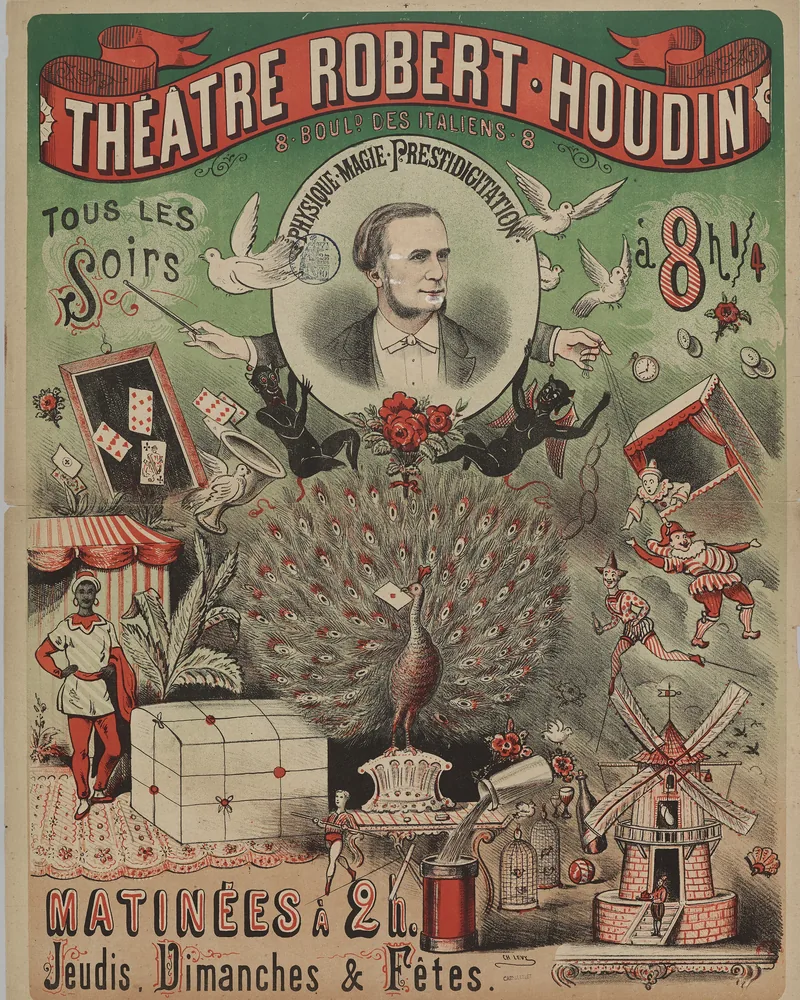
Jean-Eugène Robert-Houdin, born in Blois in 1805, was a watchmaker before he was a magician, and his skill with mechanisms shaped his act. On 3 July 1845 he premiered his Soirées fantastiques at his own theatre in Paris. The first night went badly by his own account, but he persevered and his reputation grew. He lifted conjuring out of the fairground and onto a stage with paying seats, and today's tailcoated magician is partly his invention.
London's Egyptian Hall
By the late 1800s the biggest magic shows had settled into theatres of their own for long runs. In 1873 John Nevil Maskelyne and his partner Cooke settled at the Egyptian Hall in Piccadilly, where they stayed for 31 years. Their shows used the stage itself as a tool, hiding mechanisms and assistants and controlling exactly what the audience could see. Maskelyne and Cooke invented many illusions still performed today, levitation among them, and Maskelyne also invented the substitution trunk later made famous by Harry Houdini.
The Golden Age
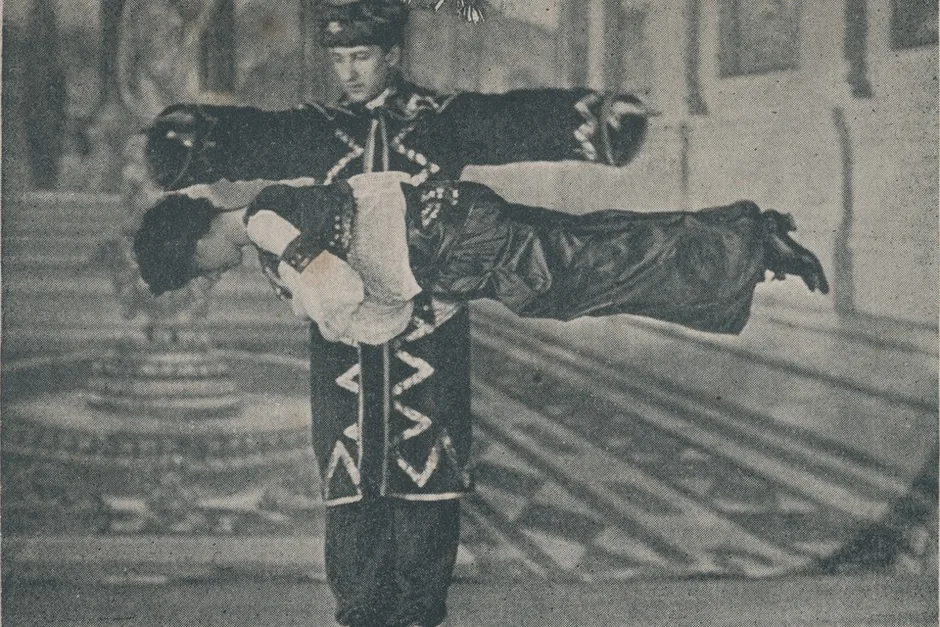
Around the turn of the 20th century, Maskelyne, David Devant, Howard Thurston, Harry Kellar and Harry Houdini all prospered in what is now called the Golden Age of Magic. Performance magic was a staple of Broadway theatre, vaudeville and music halls. Houdini borrowed his stage name from the French clockmaker. In 1921 the sawing illusion arrived, first in London with P. T. Selbit and then in the United States with Horace Goldin.
Smoke and mirrors
People still say smoke and mirrors about anything baffling, yet mirrors are rare in modern stage magic: they are heavy to install and awkward to tour. The famous mirror-and-glass trick is Pepper's ghost, which conjured a phantom on a London stage and needed a theatre built around it. John Henry Pepper, a scientist, made it a sensation on Christmas Eve 1862 in a staging of a Dickens story, and versions of it turn up today in museums, concerts and theme-park rides.
Magic organises itself
As stage magic grew into a profession, its performers began to organise. In 1905 London gained the Magic Circle, a society set up to advance the art. Magicians are known for guarding their methods closely while sharing techniques through formal and informal training within their own community, which is one reason the classic illusions survive from generation to generation while their secrets mostly stay on stage.
Las Vegas
Las Vegas became a home for big illusion shows. Siegfried & Roy were invited to perform in Las Vegas in 1967 and from 1990 headlined at The Mirage, known for white lions and tigers in their illusions. Lance Burton gave more than 15,000 shows in Las Vegas before retiring in 2010. A Las Vegas-style billing, as on the Myrtle Beach show, points to that tradition: large illusions, assistants, costume and showmanship in a theatre built for them.
Frequently asked questions
Who is called the father of modern stage magic?
Jean-Eugène Robert-Houdin, the watch-and-clock man from Blois who opened a magic theatre in Paris in 1845.
Where did Maskelyne and Cooke perform?
At the Egyptian Hall in Piccadilly, London, from 1873 for 31 years.
Sources